
Hearing the Voice of Zooplankton
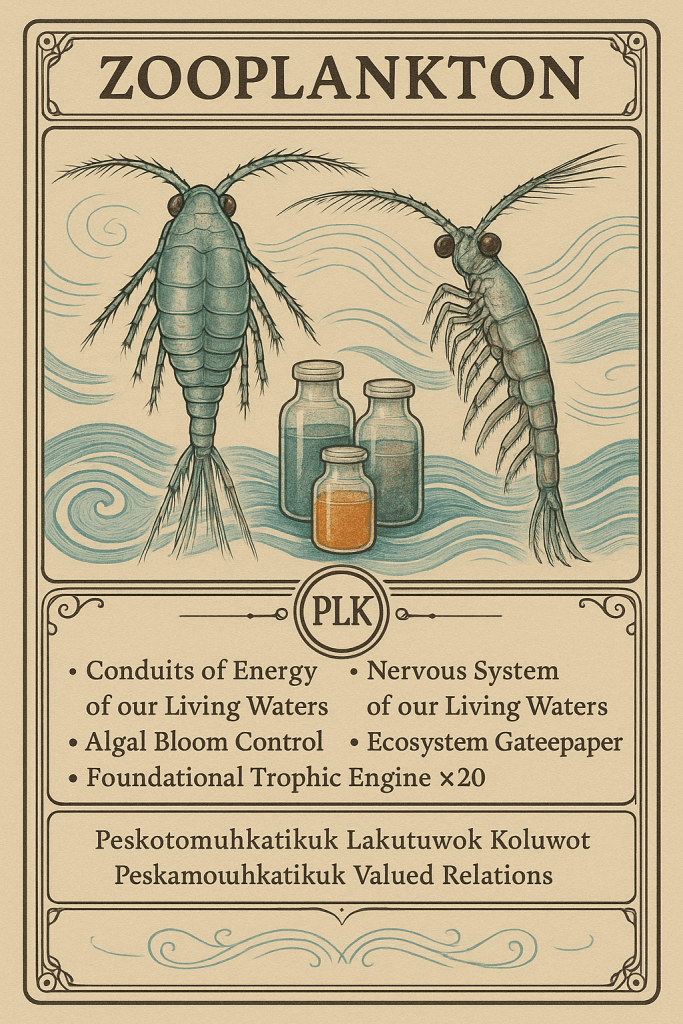
We seek to honour Zooplankton as a valued relation of the Peskotomuhkati and Passamaquoddy Bay. Click below to hear their voice and reveal short studies on the powers of Zooplankton.
Nervous system of our living waters
Zooplankton act like the “neural network” of aquatic ecosystems.
- Scientists use zooplankton as bioindicators—just as nerve signals reveal the state of a body, plankton signals reveal the state of a water body.
- They respond quickly to changes in temperature, salinity, nutrients, and light, adjusting their abundance and distribution.
- These shifts propagate through the food web, sending signals to higher trophic levels (fish, seabirds, whales) about ecosystem health.
Algal bloom control
Zooplankton graze on phytoplankton (microscopic algae).
- Their feeding activity helps maintain oxygen balance in water and prevents toxic conditions.
- By consuming algae, they regulate primary production, keeping blooms from growing unchecked.
- If zooplankton populations are reduced (due to pollution, temperature changes, or predators), harmful algal blooms can become more frequent and intense.
Foundational trophic engine
Zooplankton are the engine that powers marine food webs.
- Without zooplankton, energy from photosynthesis would remain locked at the microscopic level.
- They transform microscopic primary producers (phytoplankton) into biomass usable by larger animals.
- This “trophic transfer” of energy moves from sunlight (captured by algae) to zooplankton, to fish, and then to marine mammals and seabirds. It is what makes higher life possible in the ocean.
Ecosystem Gatekeeper
Zooplankton act as a filter and regulator for ecosystem dynamics.
- They determine which fish species thrive, because different fish larvae rely on specific zooplankton prey at early life stages.
- They control which kinds of phytoplankton survive through selective grazing.
- They influence nutrient cycling by producing fecal pellets that sink, sequestering carbon in the deep ocean.
Micro-Gift: “How is Sound Used to Measure Zooplankton?”
 peskotom.land